BillyGman
New member
Recently, another board member sent me an e-mail asking me what the difference between the twin screw and the roots supercharger is. Fortunately I was able to give him an answer, but while providing an answer for him, it made me suspect that there might be some other board members here who aren't aware of what the differences are in the two designs so here the an explanation that I wrote to him and some pics too. Enjoy:
Both designs use two internal rotors to push the air into the intake manifold as they rotate in opposite directions. However the rotors that are used are shaped differently in each of the two designs. Those used in the roots design each have three lobes on them. The lobes of each of the two rotors mesh with eachother like the cogs of gears do. But they pull the air around the outside wall of the case. The twin screw design uses two rotors that are shaped like a big screw, and they pull the air in between the two rotors instead of around the side of the case like the ones on the roots design do.
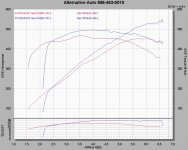
The twin screw design offers more power with less heat. It offers a power curve with as much low RPM power as the roots design, and also as much high RPM power at the centrifugal. So it's suprerior to both the roots and the centrifugal designs in it's power delivery, and is equal to the centrigugal in it's efficiency.
Of the 5 pics below, from left to right, the first and the last are both of the roots design, while the rest are of the twin screw design.....
Both designs use two internal rotors to push the air into the intake manifold as they rotate in opposite directions. However the rotors that are used are shaped differently in each of the two designs. Those used in the roots design each have three lobes on them. The lobes of each of the two rotors mesh with eachother like the cogs of gears do. But they pull the air around the outside wall of the case. The twin screw design uses two rotors that are shaped like a big screw, and they pull the air in between the two rotors instead of around the side of the case like the ones on the roots design do.
The twin screw design offers more power with less heat. It offers a power curve with as much low RPM power as the roots design, and also as much high RPM power at the centrifugal. So it's suprerior to both the roots and the centrifugal designs in it's power delivery, and is equal to the centrigugal in it's efficiency.
Of the 5 pics below, from left to right, the first and the last are both of the roots design, while the rest are of the twin screw design.....
Last edited:

 I doubt we'll ever have a twin-screw available for our cars.