An unusual variation of the o-ring problem
Well, I finally got hit with the dreaded "air only through the defroster vents" syndrome. My car came about it in an odd way. My rear bumper was in the shop for about a week (last week) while the rear bumper was being repaired. It sat outside in 98 degree weather for 2 days before I could pick up the car.
The car's HVAC system worked fine at the point that I dropped off the car for the bumper work. When I picked up the car one week later, it didn't. It should be noted that everything on the system otherwise operated properly - except for the vents.
I did the usual research on the digest here, and came up with the infamous o-ring problem.
With all the good info from several forums on this subject matter on MMnet, I printed out a bunch of the info, and thought I was loaded for bear. But the bear got me this time, sort of.
I went through the vacuum protocols first so as to insure it was indeed the EATC problem. I removed the controller and proceded to disassemble it even though I did not have the new o-rings. I really didn't find the o-rings to be all that bad, so I decided to do a little more vacuum valve/manifold diagnosis.
According to some of the posts I read, when vacuum is applied to the vacuum input of the solenoid manifold (black tube), say, with a vacuum pump (which I have), there should be little to no leakage through the solenoid valve system.
Well, mine leaked like the proverbial sieve. I disassembled the manifold as best I could to find anthing obvious, but I couldn't find a thing. FastBlackMerc responded to my email to him with encouragement, but still wanted me to change the o-rings.
The next morning (today), I was lucky enough to find an o-ring supplier right behind my place of work that had the correct part. I rebuilt the solenoids during my break, and when outside to make a quick temporary hookup of the system to try it out. And, Viola! Nuttin' honey. Same as before. In addition, I could actually hear vacuum leaking through the solenoid/manifold assembly when it wasn't even hooked up the EATC.
I spent my next break looking on-line for situations closer to mine, which I did, but couldn't find any solution to the problem. More on that below.
I started looking for replacement controllers, but decided to look closer at the manifold when I got home. At home, I decided to go the reverse vacuum route. That is, applying a slight pressure through the main vacuum input port. I used some soapy water and found bubbles forming along the tips that support the flanges of the solenoid brackets.
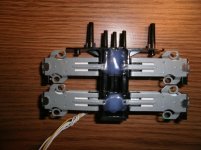
So - 8 o'clock at night - what to do? I figured I fill up the external manifold voids with RTV, but I was out of that stuff. I finally found some special high melting temperature hot-melt-glue from another project. I attached two pictures to show what I did.
I re-tested using the vacuum tester. While far from perfect, there was minimal leakage at this point. I assume that the solenoid valve seats (those little brass rods with the rubber tips on them, kept in tension at the manifold orifice with the spring) don't seal 100%. Maybe it's supposed to...I don't really know, and don't have another unit to play with to compare.
I hooked everything back up again, and this time everything worked as expected.
As you can see in the pictures, it's a little messy, but otherwise covers the areas that I found to be leaking.
I would also like to add that I found a certain number of posts in different website forums while researching today that mentioned that replacing the o-rings did not have the desired effect. My best gustimate is that this represented about 5-10% of all the posts that I read. Their only solution was to find a replacement unit, regardless whether it was new, used, or rebuilt. Having kept this particular anomoly in mind during my trials and trivulations today was just more impetus to "crack" the problem.
I'm guessing that many of the poor souls whose o-ring fix did not work for them likely had the same problem I had. And yes, I understand there are a host of other problems as well that could make it seem similar - such as electronic parts breakdown.
So, for the time being, barring any summer heat problems with the glue, I have a fix. I will still try to find a fairly priced unit somewhere that I can keep as a backup.
Even though my problem probably qualifies as an anomoly, having all this good information at my fingertips from MMnet is priceless.
I guess the only thing I could ask is if anyone else has actually tried to see if the solenoid/manifold assembly is supposed to be really airtight (when the solenoids are de-energized, of course) by using a vacuum tester.